university of the west indies
2026
five island, antigua
new construction, master planning, sustainability, landscape
collaborators
Engineering: KS&P Limited Engineers
Architecture & Engineering: PVEDI Architects & Engineers
a living laboratory — where artificial intelligence, pioneering pedagogy, and the natural environment converge to forge a new path for Antigua and the Caribbean.
Gisolfi LLP, in collaboration with KS&P Limited Engineers and PVEDI Architects Engineers, has completed the Phase One design for the new University of the West Indies Five Island Campus on the island of Antigua. This project represents a landmark moment in the advancement of higher education across the Caribbean region.
The campus is conceived to inspire collaboration, research, and creativity at every turn; to foster entrepreneurship; and to nurture the creation and growth of small businesses throughout Antigua and the wider Caribbean. At its core it is an unwavering commitment to building an inclusive, energy-efficient, sustainable, and expandable institution that elevates the academic and social lives of students drawn from across the globe.
campus design philosophy
-
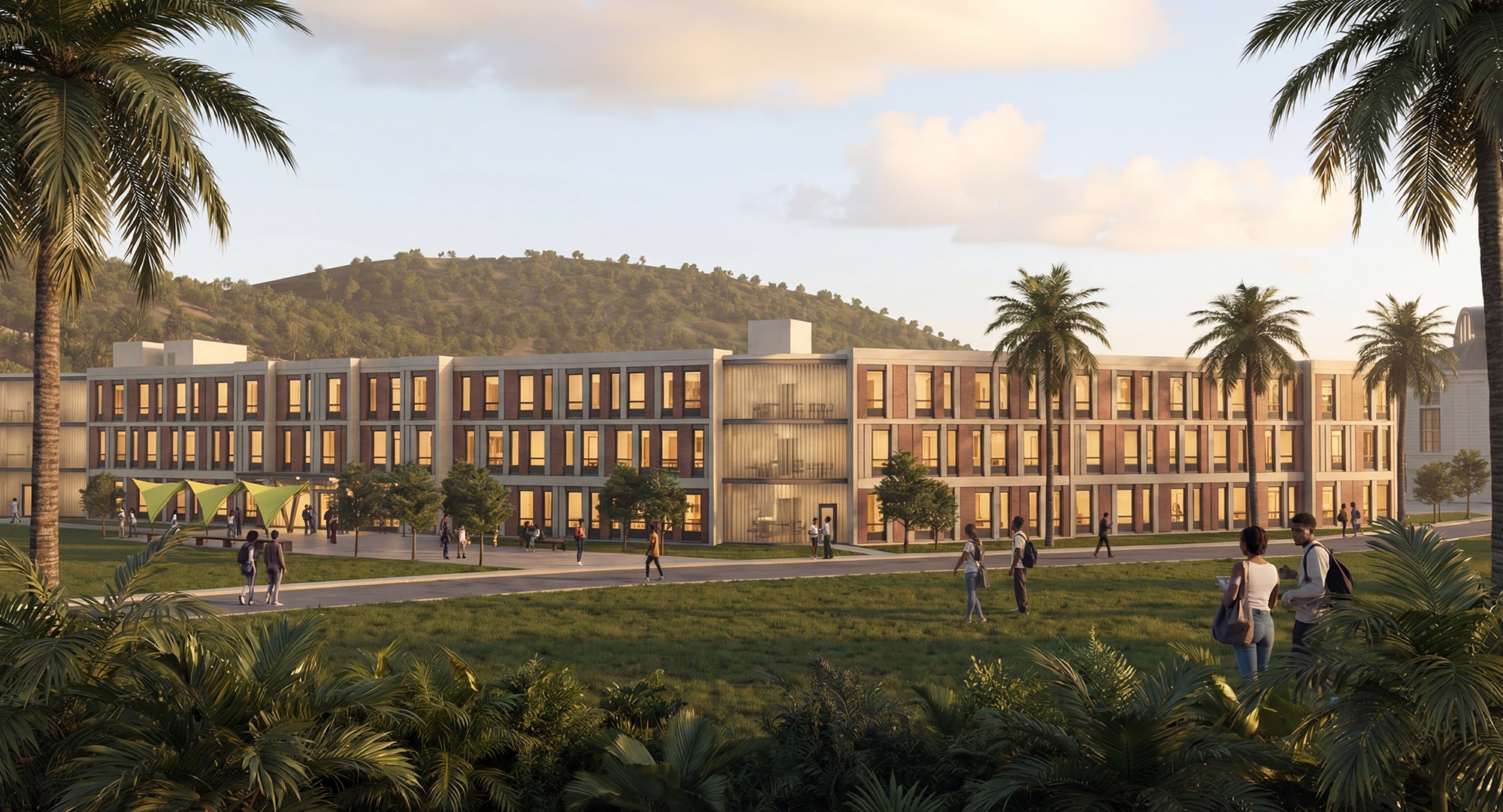
Two enduring models of academic urbanism inform the organization of the Five Island Campus.
The first is the monastic tradition, exemplified by Oxford and Princeton, in which buildings are gathered around intimate, sheltered courtyards that encourage contemplation, community, and a sense of belonging.
The second is the civic forum or agora tradition, expressed most nobly in Thomas Jefferson’s University of Virginia, in which academic life unfolds along open, socially animated promenades and greens.
-
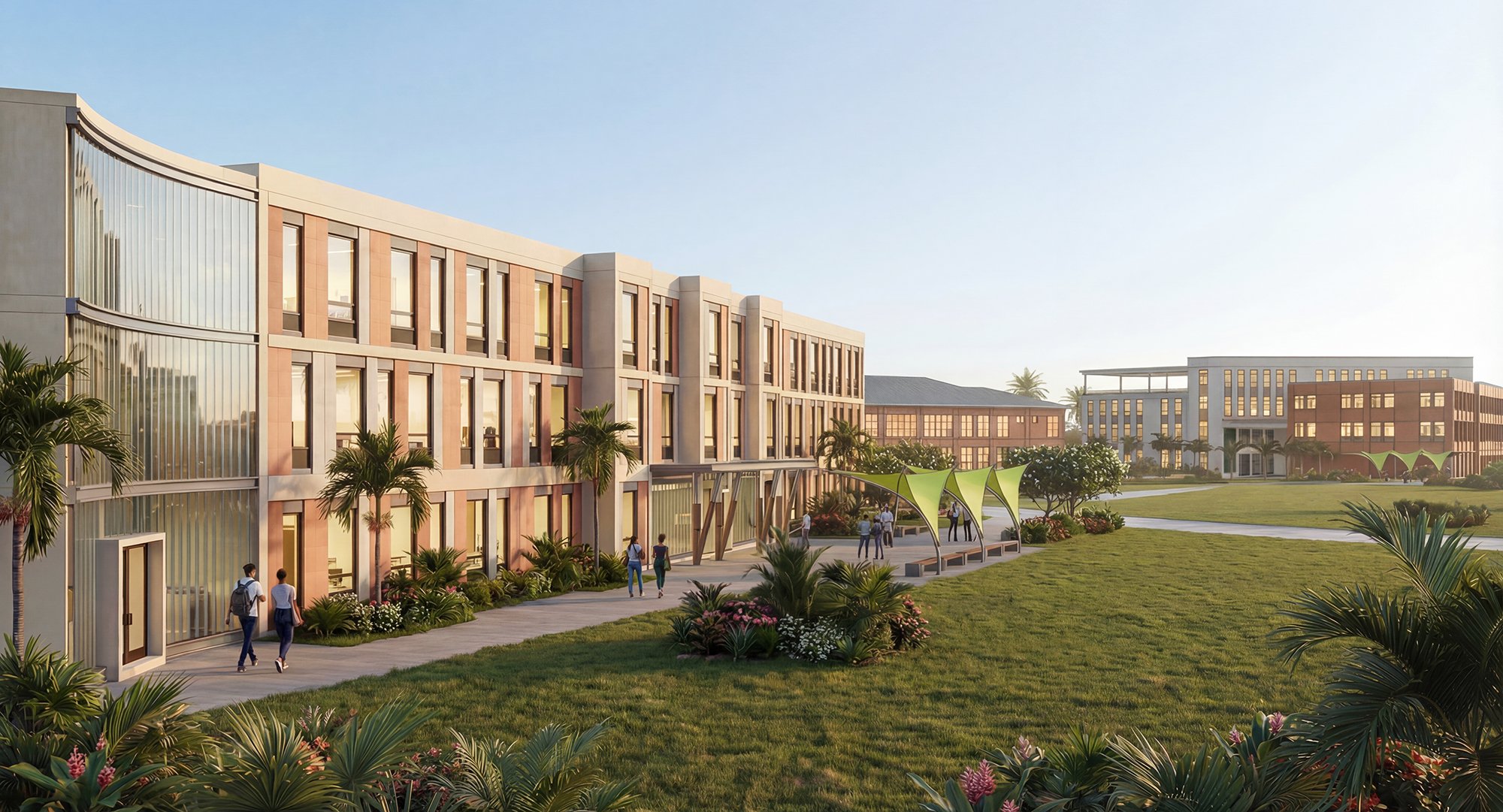
Both traditions find expression at Five Island. The monastic model is present in the residential and academic quadrangles — enclosed, purposeful, and scaled to the human figure.
The civic forum emerges along the central Student Life Promenade, a generous open spine flanked by colonnades that provide continuous shade and shelter in Antigua’s tropical climate.
Together, these traditions create a campus that is at once intimate and expansive, rooted in history and oriented toward the future.
phase one scope
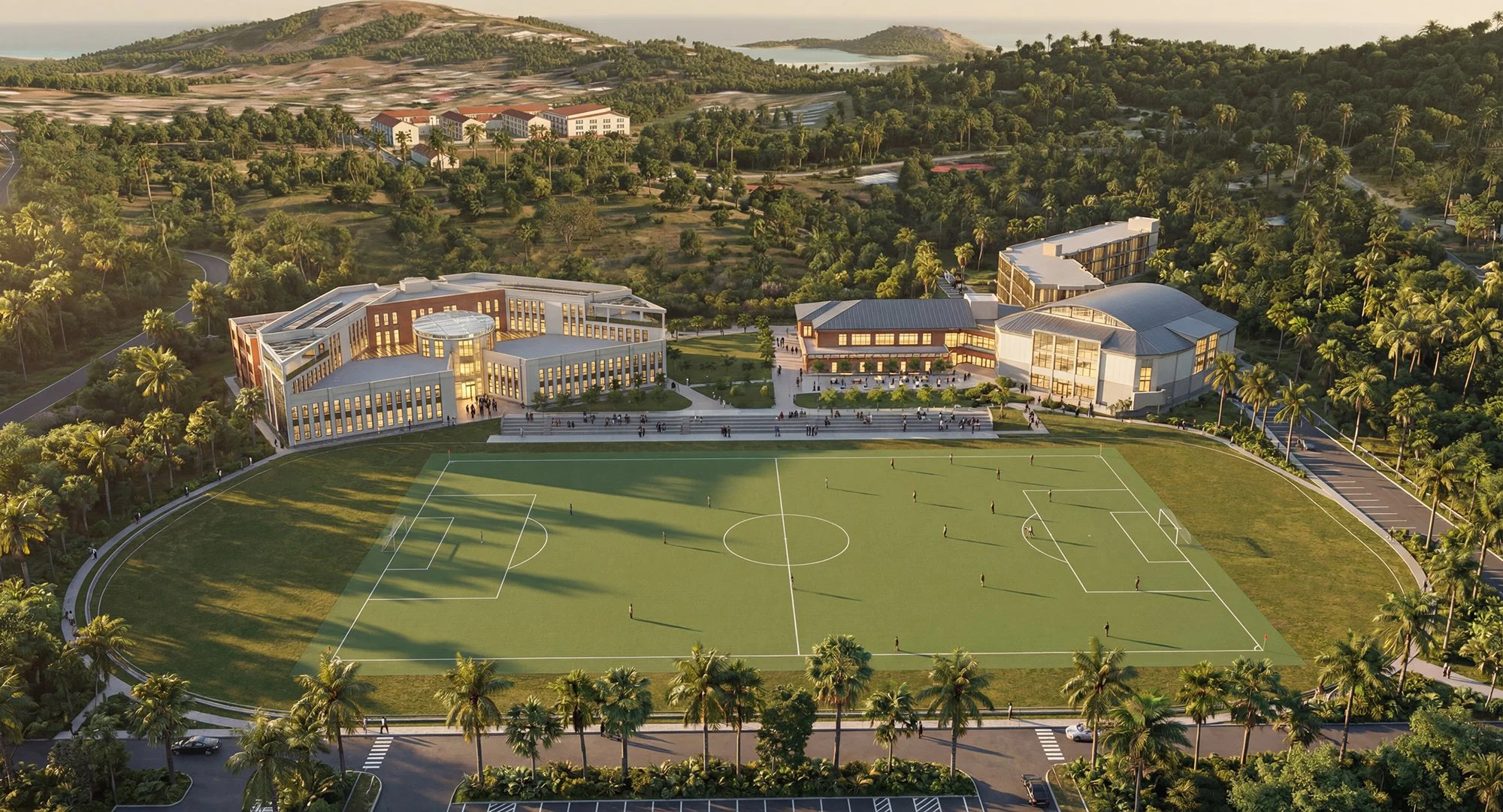
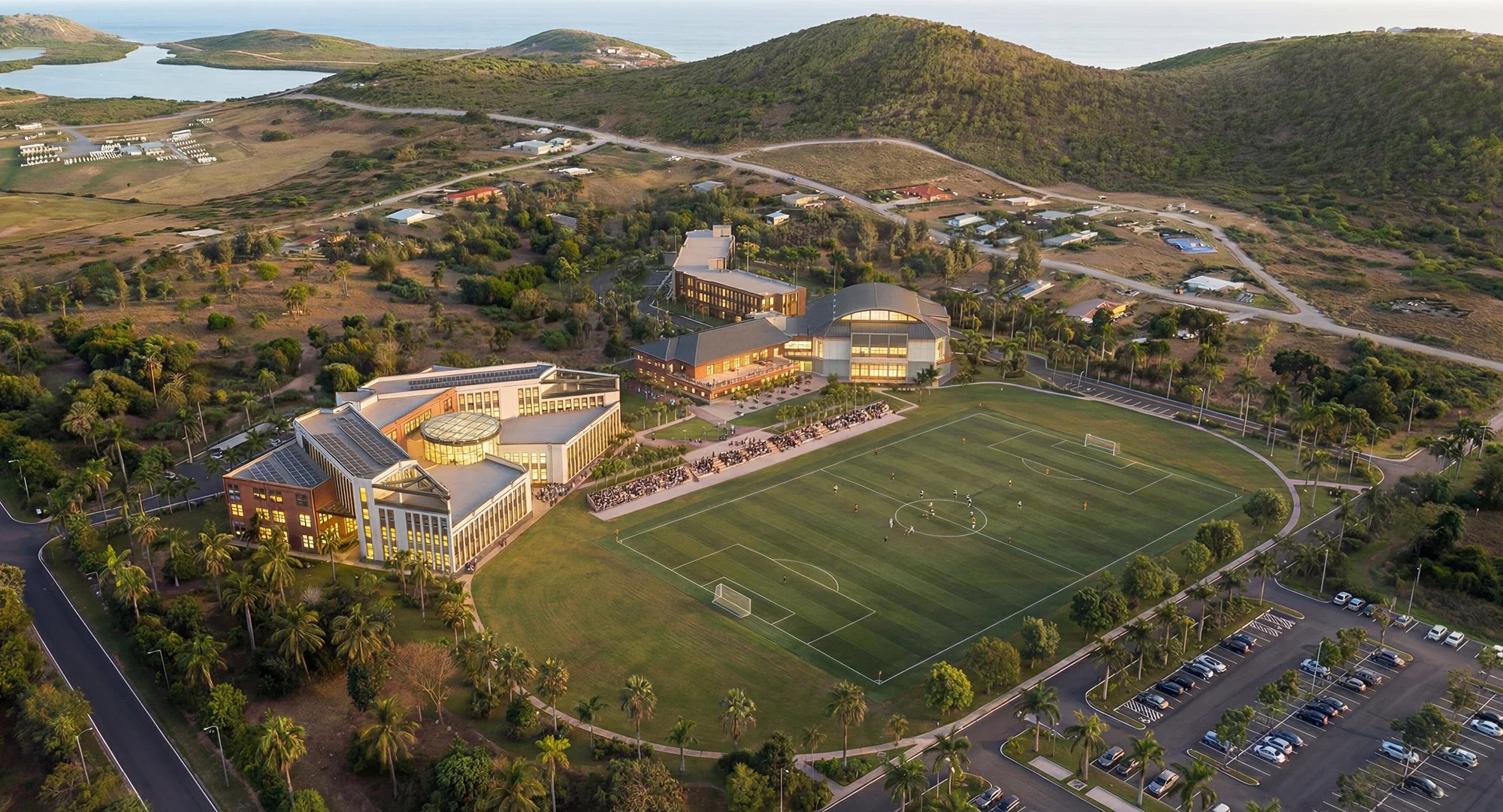
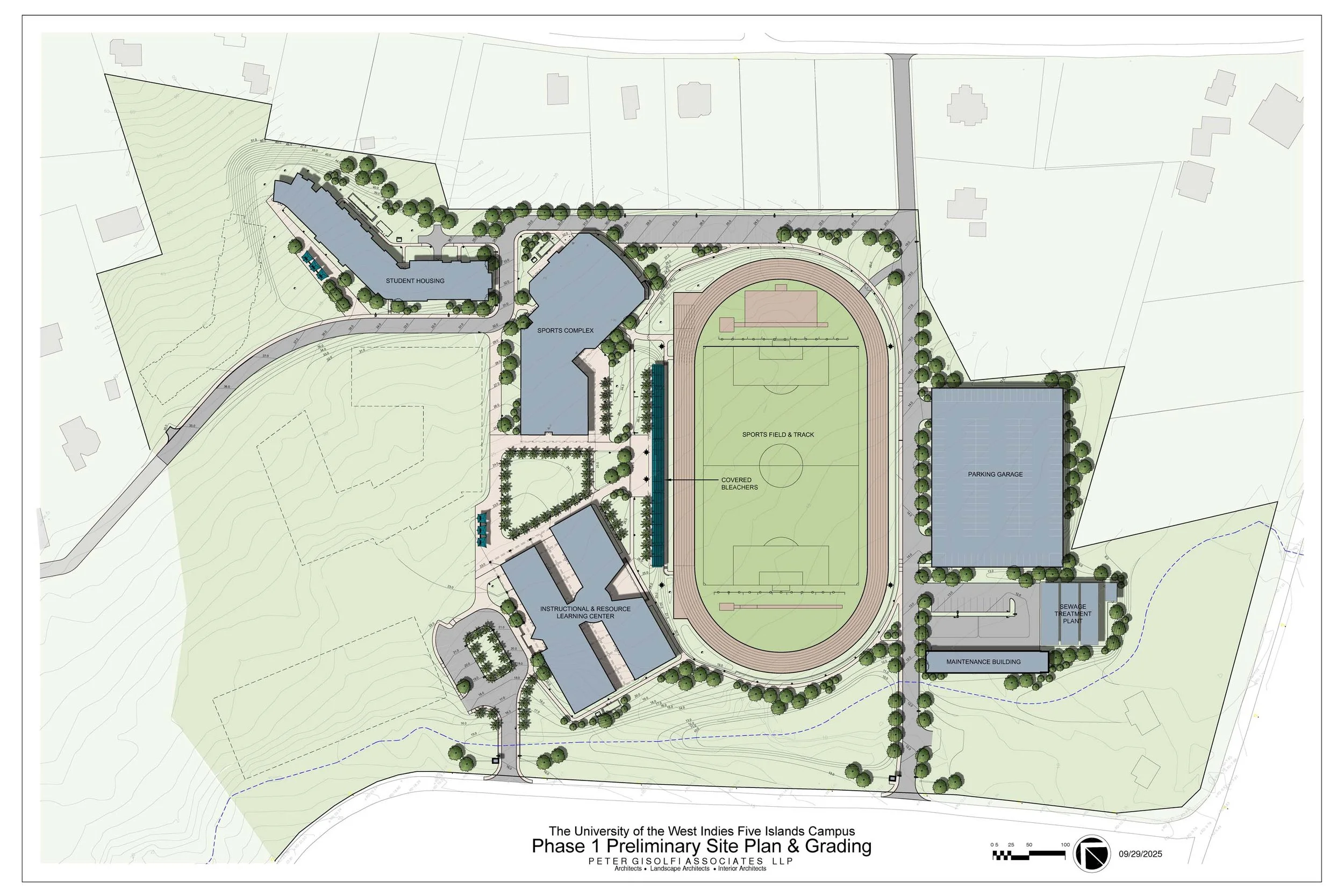
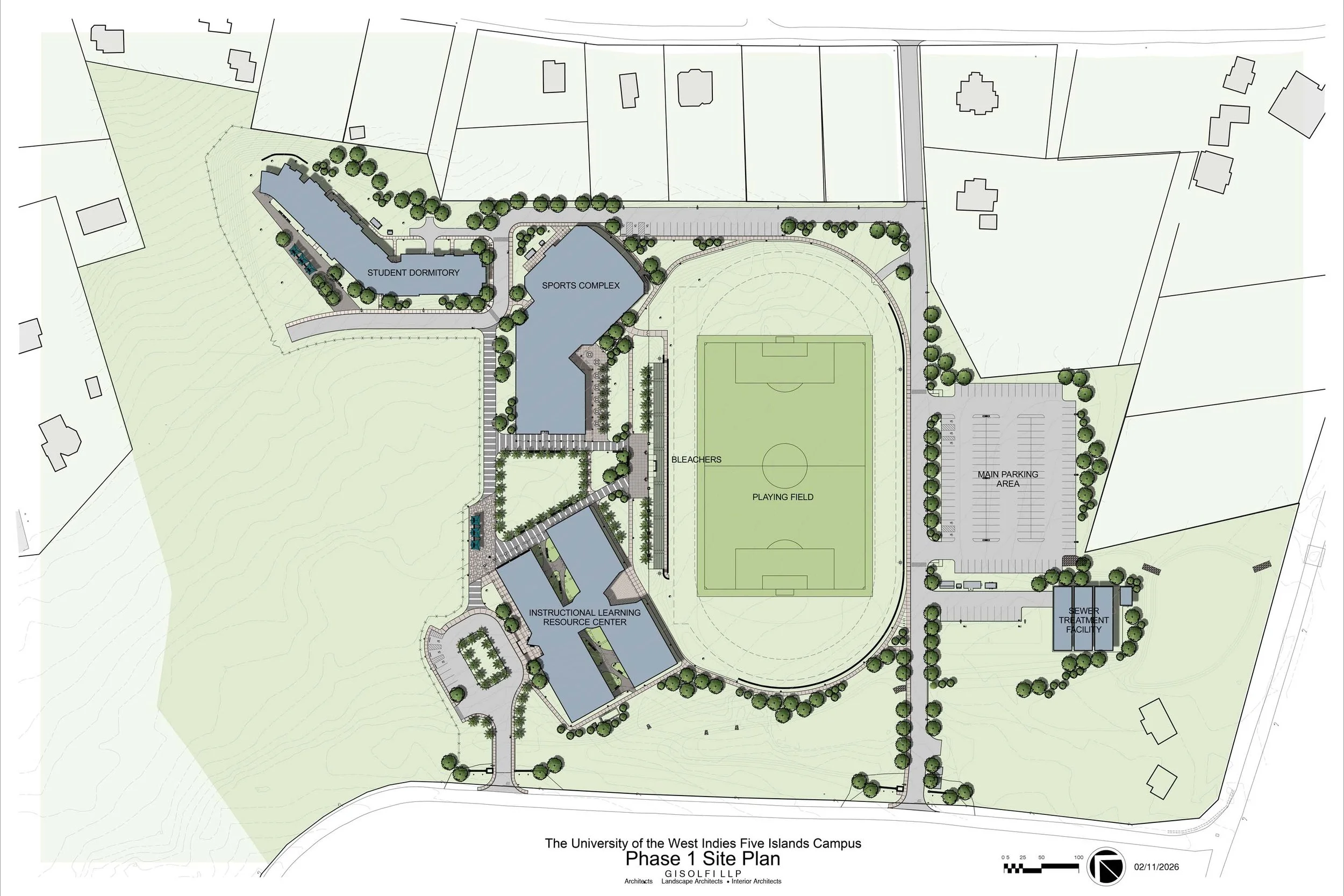
The campus site descends gently from the north-west to the south-east. Phase One occupies the south-eastern portion of the site, establishing the civic and athletic heart of the new campus. An Olympic track and competition field serve as a graceful threshold, separating the publicly accessible facilities, a future parking structure, maintenance building and yard, and a future competition pool, from the academic precinct to the west.
Phase One encompasses full site design as well as two principal buildings: the Sports Complex and the Instructional and Learning Resource Center. A third element, the School of Science, Computing and Artificial Intelligence, will be housed within the Instructional and Learning Resource Center and will serve as an intellectual engine for the entire university.
Every academic program offered at Five Island will engage SoSCAI as a core resource, equipping students with interdisciplinary fluency in science, computing, data science, and their applications in both business and scholarly inquiry.
sports complex
The Sports Complex is a split-level building that responds directly to the topography of the site and the varied scales of activity it must accommodate.
At field level, the lower floor houses locker rooms, team suites, a trainer’s suite, and essential support spaces — all positioned to serve athletes as they transition between the arena and the competition grounds.
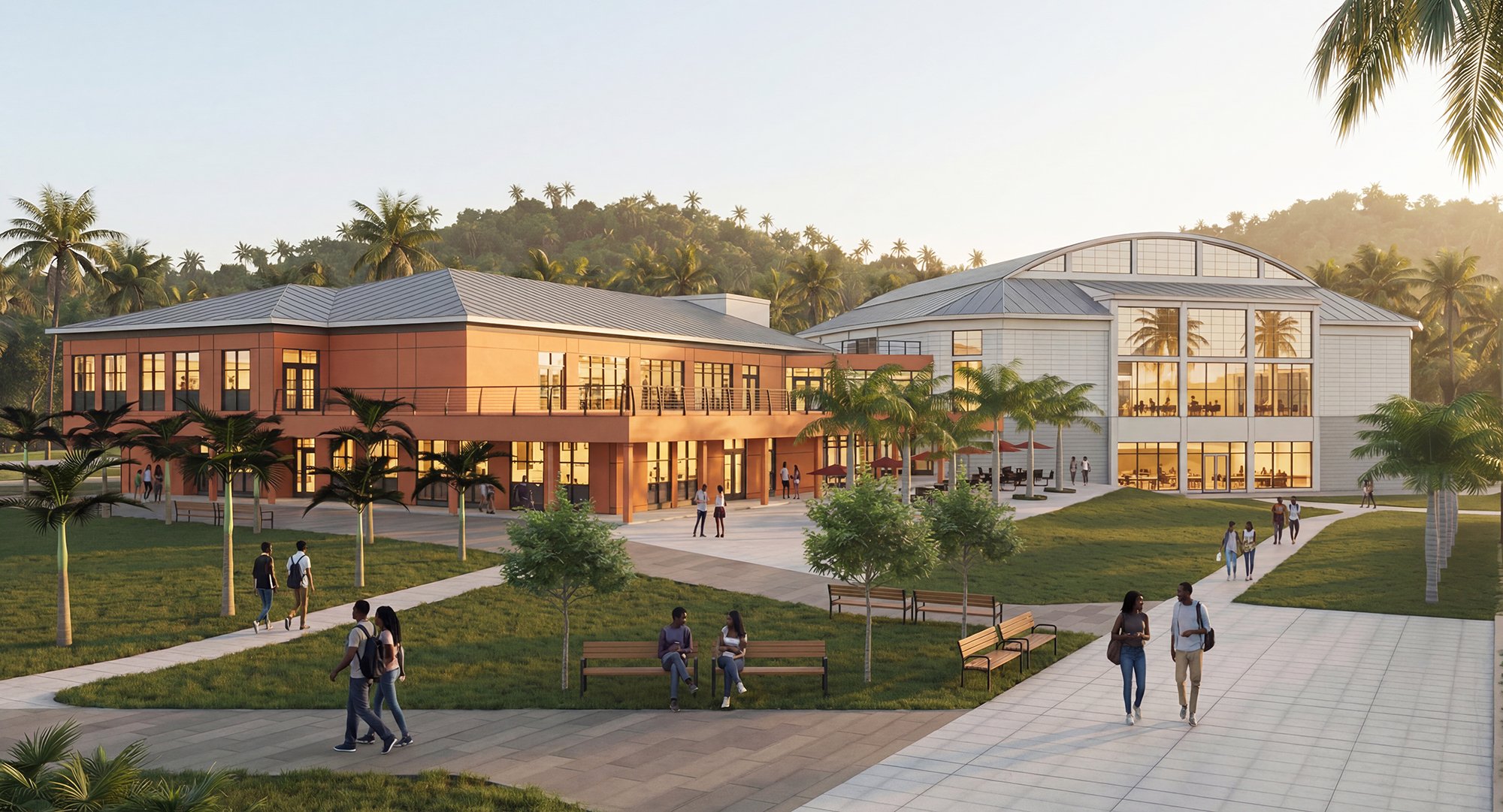
One level above, the competition sports arena presides over the complex. Midway between the lower and arena levels, a main floor extends outward, housing community and educational spaces that open the building to the broader campus population. A colonnade wraps this floor on two sides, providing shaded outdoor circulation in keeping with the campus-wide language of covered walkways.
At the crown of the building, exercise and weight rooms open onto a generous terrace that commands sweeping views of the competition field and the Caribbean landscape beyond.
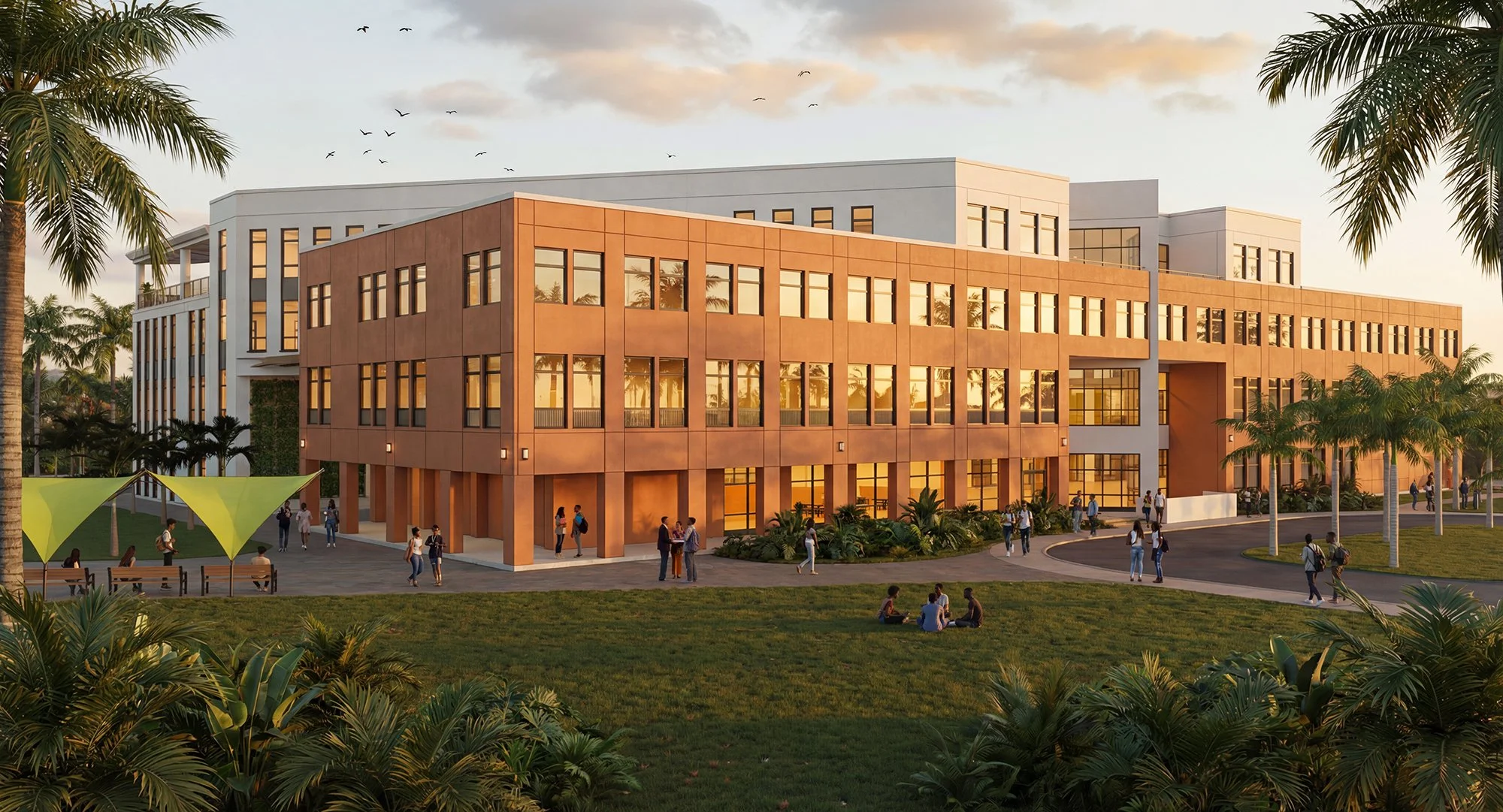
The façade is composed of precast concrete panels in limestone and terracotta tones, a palette drawn from Antigua’s vernacular and geological character, punctuated by expansive glazing oriented toward the field and prevailing views. The hip roof has been engineered to accommodate integrated solar panels set within concrete tiles, advancing the campus's commitment to energy independence and sustainability.
instructional and learning resource center
The Instructional and Learning Resource Center is a three-story building with a partial basement level. Flat roofs throughout accommodate an extensive array of solar panels, reinforcing the university’s ambition for energy self-sufficiency. The building brings together a rich variety of academic environments: seminar and lecture rooms, collaborative studios, advanced technology laboratories, faculty offices, and informal student learning spaces distributed across its interconnected sections.
The design of the ILRC is rooted in a profound engagement with the national flag of Antigua and Barbuda, an emblem whose visual and symbolic richness proved to be a generative force throughout the design process. The flag’s composition, an inverted isosceles triangle bearing a rising sun above a black field, flanked by two red Pythagorean triangles with the proportional ratios of 3:4:5 at each end, carries a layered narrative of victory, new beginnings, light, and enduring tradition.
“The flag’s symbolism — victory, new hope, light, and beginnings — became the generative force behind the architecture of the ILRC.”
The building’s plan translates this iconography into architectural form with careful precision. The building faces east, toward the rising sun over the sea, just as the flag orients itself toward the horizon of a new dawn. The top floor adopts a bold ‘V’ configuration, evoking both the flag’s central chevron and the universal symbol of victory. At either end, the massing echoes the red Pythagorean triangles of the flag. Centrally positioned, a cylindrical drum, luminous and commanding, stands in for the sun at the heart of the composition, functioning as the student center and social hub of the entire building.
Three parallel bar sections run across the plan, recalling the three stripes of the flag’s inverted triangle and the light that reaches from sun to sea to shore. A central garden bar traverses the building from end to end, flooding the interior with natural light and creating a generous planted spine that anchors the building’s ecological and social life. The overall composition maximizes daylight penetration into all occupied spaces while organizing academic departments logically along the various bar sections.
The façade continues the material language established in the Sports Complex, precast concrete panels in limestone and terracotta, providing unity across the Phase One precinct. Window openings are carefully oriented toward the competition fields, campus landscapes, and distant Caribbean views.
a new path for Antigua and the Caribbean
The flag of Antigua and Barbuda speaks of victory and new hope, of light and fresh beginnings. It commemorates the island’s proud traditions while charting an independent course toward a self-determined future. These are not merely historical sentiments; they are living aspirations that the Five Island Campus is built to embody.
The new University of the West Indies Five Island Campus offers its students, its faculty, and the people of Antigua and the Caribbean a parallel journey: an opportunity to learn, to explore, to create, and to advance knowledge and technology in a place designed expressly for that purpose. By fostering new local enterprises, deepening intellectual engagement, and connecting the island to the wider currents of global scholarship, the campus extends Antigua’s independence beyond the political into the intellectual and economic.
It is a privilege to have contributed to this vision, and we look forward with great anticipation to the realization of this extraordinary place.